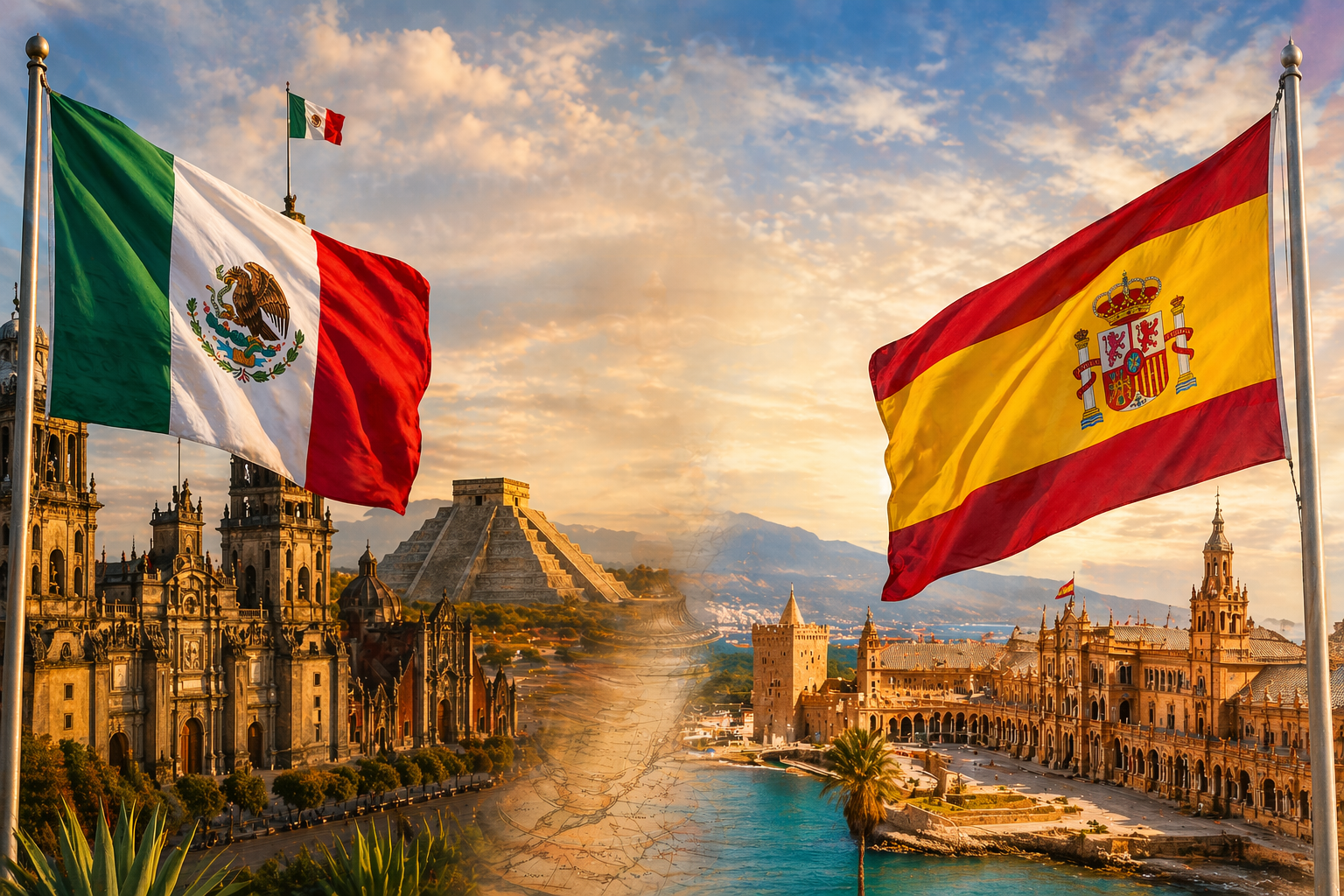
The current tension between Mexico and Spain regarding the “home” of the Gelman Santander Collection is not a traditional diplomatic crisis between two governments, but rather a dispute over ownership, possession, cultural sovereignty, and nationality.
Specifically, the issue concerns 160 works from what is now known as the Gelman Santander Collection, which are to be managed by the Fundación Banco Santander and are currently on exhibition in Mexico. The works are then scheduled to move in autumn, to Spain, to their new home, the Faro Santander Museum. This museum is to house the Santander Bank’s art collection as a new venue for art and dialogues on art, while also reflecting the bank’s international character through artworks from the various countries in which the bank operates.
After the plans to relocate the artworks from Mexico to Spain became public, criticism and fierce resistance arose in Mexico for three main reasons, some of the works are protected as national cultural heritage monuments, the collection has been only partially accessible to the public for years, and the initial announcements left open how long the works would actually remain abroad. In Mexico, people felt robbed of the legacy of Frida Kahlo, one of the artists featuring prominently in the collection.
This raises the fascinating question of the nationality of works of art, the collection, and the collector and situates the case squarely in the middle of one of the most hotly debated issues in art law: to whom should a work of art be attributed? Whose nationally valuable cultural heritage does the work of art—or the art collection—represent?
Before this question can be answered for a collection, it is always worthwhile to examine the individual histories of the collection, the artworks, and the collector, from both an art-history and an art-law perspective.
In this case, the collectors were the couple Jacques and Natasha Gelman. Jacques Gelman was born in St. Petersburg to Jewish parents. He left the Soviet Union after the Bolshevik Revolution, studied in Berlin, then worked in the film industry in Paris, and arrived in Mexico in 1938. Natasha Zahalka was from Prostejov in what was then Austria-Hungary; she was educated in Vienna and Switzerland and also came to Mexico as a European emigrant. The two married in Mexico City in 1941. Jacques Gelman made a career for himself in Mexico as a film producer and became very wealthy through his work.
At this point, we already see connections to Russia, Germany, France, Austria, Hungary, the Czech Republic, and Mexico when considering the collectors’ identities.
After emigrating to Mexico, the Gelmans were not merely buyers but close patrons. According to the Publicications from Museums a close friendship developed with Frida Kahlo and Diego Rivera in 1943; in the same year, the Gelmans commissioned both artists to each paint a portrait of Natasha. More recent art-history accounts add that the Gelmans also maintained close relationships with Rufino Tamayo and Gunther Gerzso. The Fundación Banco Santander explicitly describes the couples collecting style as a form of engagement and support: they often purchased works early on, supported emerging careers, and sought out key works by the respective artists. This is precisely why Natasha is regarded today not only as a “muse,” but as a central co-creator of the collection.
After Jaques Gelman’s death, his wife Natasha inherited the collection. Following her death, the collection passed to Robert R. Littmann. The accompanying will, which may contain further provisions regarding the collection’s future, is apparently not public.
Robert Littmann was not merely an undisputed heir; rather, as far as research has revealed, he was initially an American curator, a close advisor to Natasha, and the executor of her will. After Natasha’s death in 1998, he founded the Vergel Foundation, managed the collection, expanded it, and sent it on international tours. An early attempt to permanently display the works in Mexico led to a museum in Cuernavaca; however, inheritance disputes and challenges to Littman’s role ensured that the collection virtually disappeared from public view in Mexico starting in 2008.
Whether Natasha Gelman’s will stipulated that the collection should remain in Mexico, be moved to another country, or even be sold cannot be determined, as the will was never made public. Consequently, Robert R. Littman’s role as administrator is also controversial, as it appears he effectively assumed ownership and then sold the collection to its current owners.This lack of clarity explains why this subsequent sale to the Zambranos in Mexico was met with such suspicion. According to Santander and third parties, however, the legal situation had been reviewed and Littman was able to transfer the collection lawfully.
The latest buyers are the Zambrano family. The family’s history can be summarized briefly: It is an old industrial family from Monterrey considered as one of the most powerful families in Mexico and whose fortune is tied to CEMEX, a cement company; Lorenzo Zambrano transformed the group into a global enterprise starting in the 1980s. What is particularly important for the Gelman case is that the Zambranos are presented as Mexican collectors in the current official statements. What has been publicly communicated is primarily that the family, as a collective, acquired the collection from the Vergel Foundation in 2023; however, the available public statements do not transparently specify which individual family members are parties to the contract or whether a foundation is involved.
The debate over the nationality of the artworks intensified when works from the Gelman collection appeared at Sotheby’s in 2024. Mexico’s INBAL intervened and halted the auction, as protected works may only be exhibited or sold under strict legal conditions. Since then, the collection has been the subject of intense public scrutiny.
After acquiring the collection, the family entered into an agreement with Santander Bank, whereby the Zambrano family remains the owner and Santander assumes only the administration. The Fundación Banco Santander explicitly states that it did not purchase the collection; it is responsible for conservation, research, maintenance, and temporary exhibitions. At the same time, Santander emphasizes that the necessary permits for the temporary export of the specially protected works must be obtained in close coordination with INBAL.
The fact that Santander, of all places, is taking on this role also has to do with infrastructure. The foundation already manages the Banco Santander Collection, which comprises over 1,000 works, and has positioned itself as a cultural player for years.
Once the agreement was finalized, the collection, as mentioned above, was to move to the new cultural center the bank is establishing in the city of Santander. This venue is the renovated historic bank headquarters in the Edificio Pereda and is intended to bring together art, culture, and technology. Santander explicitly describes Faro as a new public flagship space for the city.
From the outset, Santander’s concept has been to showcase, in addition to its own banking collection, temporary exhibitions from the countries where Santander operates, collaborating with private collectors and major museums. Santander itself called the collection a “cornerstone” of the opening programme and presented it as an expression of cultural affinity between Mexico and Spain.
The dispute between Mexico and Spain escalated in early 2026 when Santander announced the administrative agreement and the debut of the collection at Faro Santander. In Mexico, this was followed by open letters from the art community; the main criticisms centered on a lack of transparency, a potential misuse of cultural heritage protection, and concerns that Kahlo’s works could effectively be permanently relocated abroad. This is particularly sensitive because Kahlo’s work has been under special protection as a “monumento artístico” since 1984 and, under Mexican law, may only be taken out of the country temporarily.
In the weeks that followed, renegotiations took place—not regarding private ownership itself, but concerning duration, oversight, and a guarantee of return. Mexico’s Minister of Culture, Claudia Curiel, stated publicly that the collection must “go and return”; during the time an exhibition featuring 68 of the works was underway at the Museo de Arte Moderno in Mexico City. The INBAL stated that export permits would only be issued once the international venues had been definitively confirmed.
After much discussion—the details of the negotiations remain unclear—a provisional solution has been reached. While this solution is fairly clear from a political standpoint, it is not entirely free of legal complications. Santander and the Mexican government agree that there will be no change in ownership, no definitive export is planned, and the protected works will return to Mexico in 2028. This has been reaffirmed. Thus, the core conflict has been defused for the time being.
Nevertheless, the debate is not entirely over. The Guardian reports, citing the contract it has reviewed, that Faro Santander may manage the collection between June 2026 and September 30, 2030, with an option to extend. It is precisely this contradiction between the public commitment to return the works in 2028 and the broader contractual logic that prompt many in Mexico to speak of this being only a partial and not a final, solution.
From an art law perspective, this case is fascinating because it raises questions about the nationality of an art collection, the protection of culture, and property rights. It also once again brings up the debate over why art should not, or ought not, leave the country. Santander wanted to open a museum in Spain featuring artworks from Mexico to highlight relations with Mexico and showcase its art—essentially considering it an honour for Mexican art, and specifically a contribution to the visibility of Mexican art. Mexico fears losing the collection and thus no longer having its own art within the country. A conflict that is not based on the usual questions of theft or robbery found in art law, but on a more basic one – identity: What nationality does an art collection have? That of the collectors, the artist, or the place where it is located.