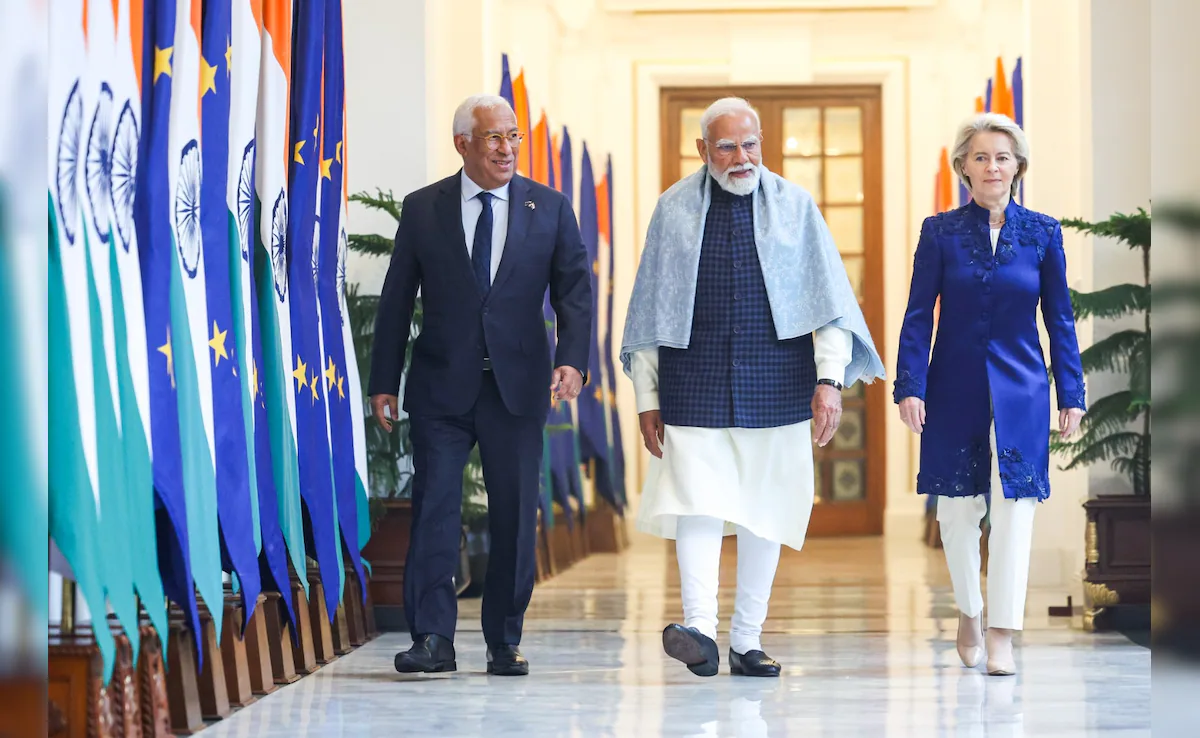
The global automotive landscape has just witnessed a seismic shift. On January 27, 2026, the formal announcement of the India-European Union Free Trade Agreement (FTA) effectively dismantled the long-standing “Fortress India” reputation of the world’s third-largest automotive market. For European automotive parts manufacturers—particularly the sophisticated German “Mittelstand”—the status quo of prohibitive 70% to 110% tariffs is officially over. We are entering an era where 97.5% of traded value will see duties vanish, fundamentally restructuring how industrial components move from the Rhine to the Ganges.
With bilateral trade in goods already reaching €120 billion in 2024 and services trade surging toward €60 billion, this agreement provides a roadmap for a new era of expansion. It provides a legal architecture that rewards early movers with unprecedented market access. For German manufacturers, the agreement’s aggressive five-to-ten-year phase-out of auto-part tariffs means that the cost of doing business in India is about to drop to its lowest level in history. If you have been waiting for a clear signal to scale your Indian operations, the finalisation of this 2026 pact is your green light.
Unprecedented Tariff Liberalisation
One of the most immediate benefits for European exporters is the massive reduction of trade barriers. The EU will eliminate tariffs on 99.5% of items from India, while India has granted concessions on 97.5% of the traded value between the two economies. This creates a high degree of reciprocity that favours high-value industrial exports.
In key industrial sectors, India is slashing tariffs on automobiles from as high as 110% down to 10% over a five-year period. This is a game-changer for European automotive giants and their complex supply chains. Furthermore, high duties on machinery and chemicals, which previously reached 22%, are being removed, with many lines liberalised at the moment of entry into force. For the German manufacturing sector, this includes immediate relief for specialised chemicals (current tariffs of up to 22%) and plastics, many of which will see duties removed mostly at entry into force or after 7 years.
The agreement also extends to agri-food and luxury segments. Prohibitive tariffs on wine, previously at 150%, are being reduced to 75% immediately and will eventually drop to 20%. Duties on olive oil, chocolates, and pastries are also being phased out, which enhances the overall business environment for European expatriates and luxury lifestyle brands supporting the industrial sector.
Total Abolition of Auto Component Tariffs
While vehicle tariffs follow a gradual reduction path, the treatment of automotive parts is significantly more aggressive to encourage local assembly and “Make in India” initiatives. This creates a massive opportunity for German Tier-1 and Tier-2 suppliers.
India has committed to the complete elimination of duties on auto components within a five to ten-year window. Many speciality components and heavy machinery used in automotive manufacturing will see tariffs—currently ranging from 7.5% to 15%—significantly reduced or removed upon the agreement’s entry into force in late 2026. This full removal of tariffs is expected to boost manufacturing interests on both continents, allowing for a seamless exchange of high-tech parts between European R&D centres and Indian assembly lines.
The “Luxury” Opportunity and CKD Kits
For European suppliers, the rapid growth of the luxury vehicle segment in India offers a high-margin entry point. The reduction of Completely Built Unit (CBU) tariffs from 110% down to 10%, under an annual quota of 250,000 vehicles, is expected to trigger a surge in demand for European premium brands.
For German companies like Mercedes-Benz, BMW, and Audi—who already locally assemble over 90% of their Indian sales—the FTA further lowers the cost of Completely Knocked Down (CKD) kits, which currently attract a duty of approximately 15%. Additionally, the agreement simplifies the import of spare parts for existing European vehicle models, including exemptions for older “end-of-production” models that previously faced complex licensing hurdles.
Modernised Rules of Origin (RoO) and Compliance
The FTA introduces “modern” Rules of Origin that provide the administrative certainty European businesses have long requested. To qualify for preferential treatment, products must fulfil either a value-added rule or a change of subheading (CTSH) rule.
Crucially, the agreement allows for full bilateral cumulation. This means that any value created or materials sourced within the EU or India count toward the origin requirement, facilitating deep industrial partnerships between German headquarters and Indian subsidiaries. Furthermore, businesses can now use average material price calculations over a minimum period of one year, providing significantly more certainty when declaring origin and reducing the administrative burden of daily price fluctuations.
The Future of Mobility: EVs and Digital Value Addition
As the industry pivots toward Software-Defined Vehicles (SDVs), the FTA sets new standards for future mobility. While Internal Combustion Engine (ICE) vehicles see immediate cuts, Electric Vehicles (EVs) are subject to a five-year grace period to protect India’s nascent local ecosystem, after which they will follow a similar tariff reduction structure.
The agreement also recognises digital value addition, which can account for up to 40% of a vehicle’s value. This favours European brands with high software investments and nudges them to expand their engineering hubs in India. To align with European sustainability goals, the deal establishes standards for battery passports and lifecycle tracking, reducing dependency on non-FTA supply chains.
A Secure Framework for Services and Digital Trade
For European service providers and engineering firms, the 2026 agreement goes far beyond standard WTO commitments. India has provided predictable access to 144 subsectors, including IT, professional services, and education.
The dedicated chapter on Digital Trade integrates rules on software source code protection. This ensures German tech firms can operate in India without the fear of mandatory source code disclosure, a vital protection for proprietary automotive software. New provisions also facilitate the temporary movement of contractual service suppliers and independent professionals, making it easier for European experts to manage Indian operations and technical transfers on the ground.
Intellectual Property and Investment Protection
The 2026 FTA establishes a modern, rules-based framework that addresses long-standing concerns regarding the Indian regulatory environment. The agreement reinforces TRIPS-level protections for trademarks, designs, and trade secrets. It includes robust measures and remedies for the enforcement of these rights against infringement and piracy, providing the security needed for high-tech manufacturing.
A new transparency chapter mandates that all trade-related measures be published through official channels with clear explanations, providing the predictability that European boards of directors demand. Additionally, for the first time, India has committed to legally binding and enforceable provisions on labour standards and environmental protection within a trade deal, aligning Indian operations with European ESG requirements.
Beyond the EU: The EFTA Advantage
It is essential for German businesses to note that India’s integration with the continent is multi-layered. On October 1, 2025, the India-EFTA Trade and Economic Partnership Agreement (TEPA) officially came into effect. This agreement with Switzerland, Norway, Iceland, and Liechtenstein includes a unique, binding commitment from the EFTA nations to invest $100 billion in India over 15 years. For German businesses with subsidiaries or partnerships in Switzerland, the TEPA offers a “single-window” investment facilitation mechanism through the EFTA Desk in India.
Comparative Analysis: RoO for Automotive Parts
For German manufacturers, navigating the overlapping trade regimes is a strategic necessity. While both the India-EU FTA and the India-EFTA TEPA aim to integrate supply chains, they vary in their administrative approaches and “cumulation” rules.
| Feature | India-EU FTA (2026) | India-EFTA TEPA (2025) |
| Primary Rule | Choice between Value-Added (VA) or Change in Tariff Subheading (CTSH). | Combination of CTSH and a minimum 40% Value-Added threshold. |
| Cumulation | Full Bilateral Cumulation: Materials from any of the 27 EU member states count as “local”. | Regional Cumulation: Materials from Switzerland, Norway, Iceland, and Liechtenstein are cumulated. |
| Value Calculation | Annual Averaging: Allows manufacturers to use average material prices over 12 months. | Transaction-Based: Typically relies on the value of specific consignments. |
| Certification | Self-Certification: Registered exporters (REX system) can issue statements on origin. | Mixed System: Requires official Certificates of Origin or Approved Exporter declarations. |
The India-EU FTA is generally more efficient for direct exports from German factories, as it allows for “full bilateral cumulation” across the entire EU bloc. Furthermore, the provision for Annual Averaging is a significant business-friendly feature. In the automotive sector, where the prices of raw materials like steel and semiconductors fluctuate daily, this allows your compliance team to set a stable “origin status” for a product line for an entire year.
The India-EU FTA also places a heavy emphasis on Self-Certification and “post-clearance audits”. This reduces “red tape” at the port of entry but increases the legal burden on the manufacturer to maintain immaculate records for five years.
Lessons from the Labyrinth: Avoiding the “Mercosur Trap”
For any European business leader, the phrase “Free Trade Agreement” often comes with the caveat of the long-stalled EU-Mercosur deal. While that agreement has languished in legislative purgatory, the India-EU FTA has been engineered to avoid the same fate.
Despite a formal signing in early 2026, the European Parliament referred the Mercosur pact to the European Court of Justice (ECJ) for a judicial review, a move driven by political pressure from agricultural and environmental groups that could delay ratification by two years or more. The core friction in the Mercosur deal—often dubbed “cars for cows”—is the fear that cheaper South American agricultural imports will undercut European farmers.
The India-EU FTA bypasses these bottlenecks because the economies are complementary. Europe seeks a high-tech manufacturing partner, and India seeks to become a global hub for European industrial supply chains. Learning from the Mercosur delays, negotiators included a robust Trade and Sustainable Development (TSD) chapter from the outset. By making the Paris Agreement an “essential element” and incorporating enforceable labour standards, the India-EU FTA addresses the environmental concerns that stalled the Mercosur deal. Furthermore, the geopolitical imperative to diversify supply chains has created a political consensus in the EU Parliament that simply does not exist for the Mercosur pact.
While the Mercosur deal remains in “legal limbo,” the India-EU FTA is moving directly into legal scrubbing and translation. The goal is to present a clean, modern text to the European Parliament that focuses on the €4 billion in annual duty savings for European exporters. For your business, this means the risk of a “Mercosur-style” multi-decade delay is significantly lower. The focus should remain on the late-2026 implementation window, ensuring your supply chain is ready to pivot the moment the first tariff cuts go live.
Conclusion
The window of opportunity created by the 2026 India-EU FTA is massive, but it is also technically complex. Navigating the modernised Rules of Origin and the Annual Averaging provisions requires more than just a logistical shift; it requires a robust legal strategy that bridges European compliance with Indian operational reality.
With the India-EFTA TEPA already in force as of 2025, providing an additional $100 billion investment track, the competitive landscape in India is becoming increasingly sophisticated. Manufacturers who rely on legacy import models will quickly find themselves outpaced by those leveraging the bilateral cumulation and self-certification benefits of the new regime. The future of automotive manufacturing is no longer about choosing between Europe and India; it is about building a seamless, tariff-free bridge between the two.
As we move toward the official signing and implementation, my role is to ensure that your business transition is not just compliant but optimised for the massive growth this agreement promises. The India-EU FTA is expected to be implemented within the 2026 calendar year, and for European companies, the window to strategise is now. Navigating these product-specific rules and ensuring IP compliance in this new regime requires a localised legal perspective to fully capture the advantages of this historic accord.